Background
Semiconductor-based qubits that utilize the spin of individual electrons or holes (also known as spin qubits) are among the most fascinating qubit platforms, as they are, for example, compatible with existing complementary metal–oxide–semiconductor (CMOS) technology [1]. In recent years, germanium (Ge)- based spin qubits have gained prominence in research, as they effectively circumvent many challenges faced by other material systems, such as the valley states in silicon or the nuclear spins in gallium arsenide.
A common approach to read out the qubit state is radio-frequency (RF) reflectometry, which aims to increase bandwidth and reduce readout duration. Here, an LC resonator on a printed circuit board (PCB), consisting of classical surface-mount device (SMD) components or superconducting resonators, is coupled to an ohmic contact of the quantum dot spin qubit device. An RF carrier signal is fed into the circuit. A change in the chemical potential of the quantum dot alters the reflected signal, enabling readout. A major challenge is achieving impedance matching between the quantum device and a characteristic 50 Ohm transmission line that feeds the signal. Therefore, the LC resonator is equipped with a so-called varactor, placed prior to the coil, which acts as a dedicated gate-tunable matching capacitor to enable in situ impedance matching [2].
These varactors can be made of a thin metal ring structure on a quantum paraelectric substrate such as strontium titanate [3]. It is crucial to understand the impedance profile of this device as a function of the applied gate bias. This impedance can be measured with a cryogenic impedance bridge (see Fig. 1), in which two sine waves, one from the device under test and one from a known reference resistor, interfere destructively, resulting in a minimum in the output voltage. Since the resulting signal will be very small, it is amplified using a packaged highelectron- mobility transistor (HEMT) [4]. Finding the point of destructive interference, the so-called bridge point, involves optimizing and analyzing a broad parameter space. From the bridge point, we can then precisely determine the impedance and correspondingly improve qubit readout times.
Your Task
You will be responsible for establishing a precise measurement and analysis workflow to determine the impedance profile of various devices under test with an ultra high frequency lock-in amplifier (UHFLI), as a commercial LCR-meter would do, but in an adiabatic demagnetization refrigerator (ADR) at an operating temperature of approximately 3.5K. You will acquire a strong experimental skill set:
- Lock-in amplifier measurement techniques and fast digital instrument control
- Measurement code writing with the in-house measurement framework QCutils and plotting tool Qimchi
- Operation and understanding of vacuum and low-temperature setups
- Physics of electronic band structures, quantum components and general quantum technology
Additionally, you can participate in group seminars and journal clubs to learn more about current developments in this research field. You will gain insights into the work of SQUAD Lab and the Quantum Technology Group. You should be self-motivated and able to work independently. Given that all of our measurements are code-based, we require you to have some basic knowledge of Python, an interest in experimental electrodynamics, and an interest in working in solid-state physics.
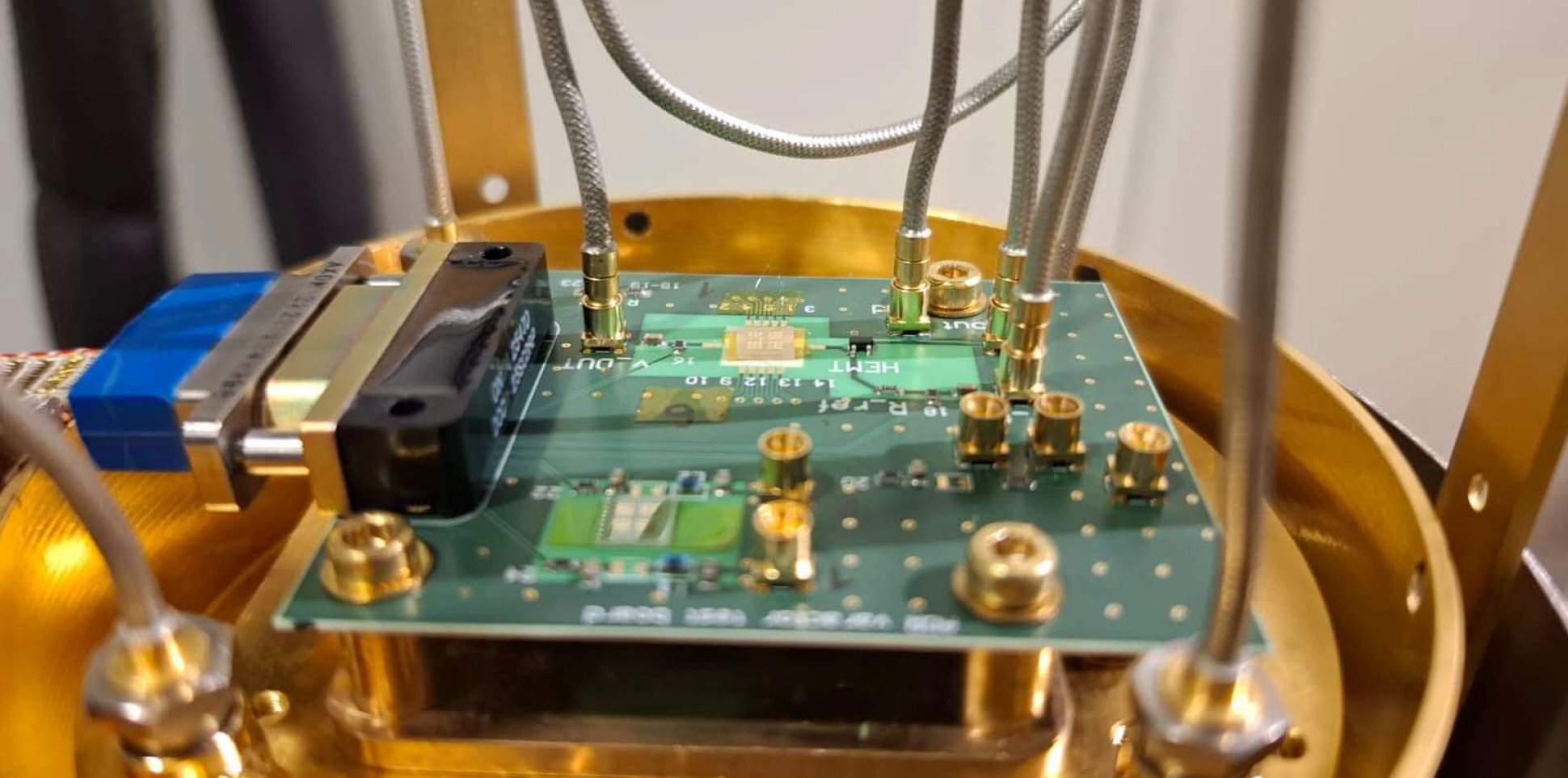 Preliminary setup of the impedance bridge in the ADR.
What we offer
- Workplace, laptop for duration of the project.
- Young, international, dynamic workplace, located on Campus Melaten (Campus Boulevard 79)
- Exposure to leading research activities in quantum technology
Supervision
- Lino Visser, FZ Jülich, PGI-11 [email protected]
- Simon Schreibing, FZ Jülich, PGI-11 [email protected] (for further project questions)
- Dr. Vincent Mourik, FZ Jülich, PGI-11 [email protected]
- Prof. Hendrik Bluhm, FZ Jülich, PGI-11 [email protected]
References
[^1] G. Scappucci et al. “The germanium quantum information route” (2021) DOI: https://doi.org/10.1038/s41578-020-00262-z [^2] N. Ares et al. “Sensitive Radio-Frequency Measurements of a Quantum Dot by Tuning to Perfect Impedance Matching” (2016) DOI: https://doi.org/10.1103/PhysRevApplied.5.034011 [^3] R. S. Eggli et al. “Cryogenic hyperabrupt strontium titanate varactors for sensitive reflectometry of quantum dots” (2023) DOI: https://doi.org/10.1103/PhysRevApplied.20.054056 [^4] G. J. Verbiest et al. “Integrated impedance bridge for absolute capacitance measurements at cryogenic temperatures and finite magnetic fields” (2019) DOI: https://doi.org/10.1063/1.5089207